US Labor Market 2026: 4.1% Unemployment & Sector Shifts

The US labor market in 2026 is anticipated to reach a 4.1% unemployment rate, reflecting a landscape significantly reshaped by technological advancements and pronounced shifts across key economic sectors.
The landscape of work in America is constantly evolving, and the US labor market in 2026 presents a fascinating picture of both stability and dynamic change. As we look ahead, what can we expect regarding unemployment, job growth, and the industries that will define our economic future? Let’s explore the projections and underlying forces at play.
Understanding the 4.1% Unemployment Projection
The forecast of a 4.1% unemployment rate for the US in 2026 signals a mature and relatively stable labor market. This figure, often considered near full employment by economists, suggests that most individuals seeking work will find opportunities. However, the headline number only tells part of the story, as underlying currents are reshaping who works where and how.
Achieving and maintaining this rate involves a delicate balance of economic policies, technological adoption, and global economic conditions. A 4.1% rate indicates a healthy demand for labor, but it also points to ongoing structural changes that require workers and businesses to adapt. This balance is crucial for sustained economic growth and individual prosperity.
Factors Influencing Unemployment Stability
Several key factors contribute to this projected stability. Robust consumer spending, continued investment in infrastructure, and a generally resilient corporate sector are foundational. Additionally, demographic shifts, such as an aging workforce and evolving labor force participation rates, play a significant role in shaping the overall supply of labor.
- Monetary Policy: The Federal Reserve’s approach to interest rates and inflation management will be critical in preventing overheating or slowdowns.
- Global Economic Health: International trade relations and global supply chain stability directly impact US manufacturing and export-oriented sectors.
- Technological Integration: Automation and AI continue to transform job roles, leading to both job displacement and the creation of new, specialized positions.
- Workforce Demographics: Retirement rates and immigration patterns influence labor supply and demand dynamics across various industries.
The 4.1% unemployment rate in 2026, therefore, is not merely a number but a reflection of complex interactions within the broader economic ecosystem. It suggests a labor market that, while strong, is also undergoing significant evolution, demanding adaptability from both employers and employees.
Key Sectoral Shifts Driving the 2026 Job Market
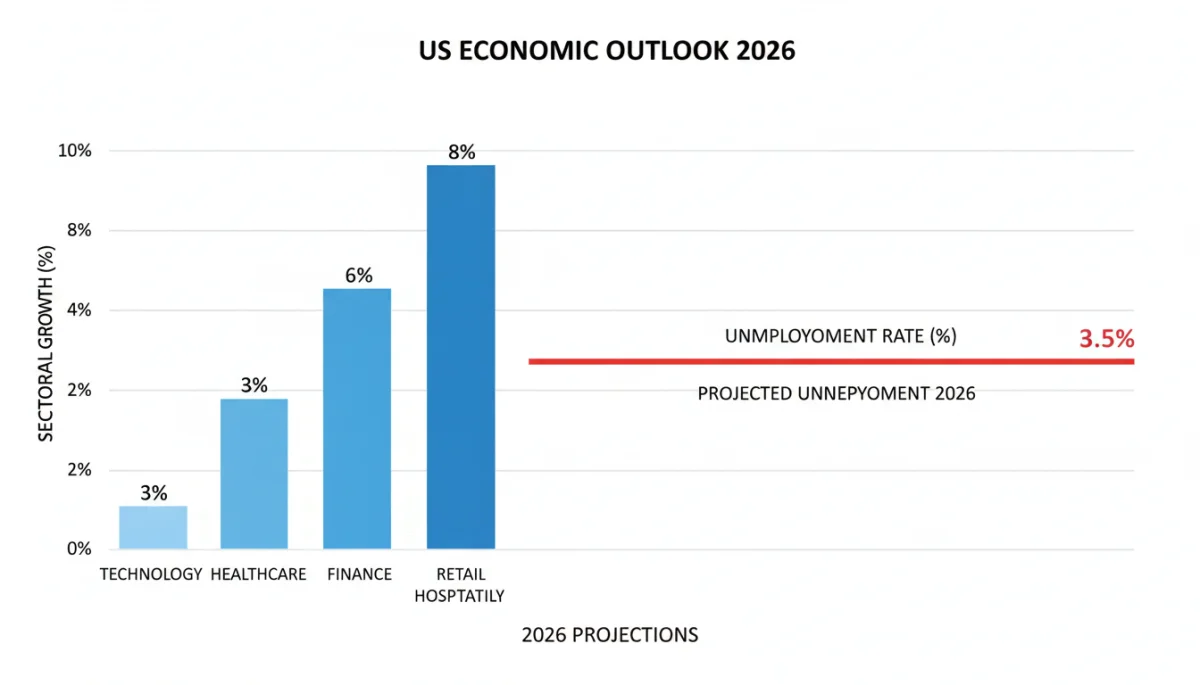
Beyond the overall unemployment rate, the US labor market in 2026 will be characterized by notable sectoral shifts. Traditional industries are adapting, while emerging sectors are experiencing rapid expansion, creating new job categories and skill demands. These shifts are fundamental to understanding where future opportunities lie and where workers might need to reskill.
The transition is not uniform; some sectors will see modest growth, while others will undergo profound transformations. This dynamic environment requires a keen eye on emerging trends and a proactive approach to workforce development. Understanding these shifts is essential for policymakers, educators, and individuals planning their careers.
Growth in Green Energy and Sustainability
The push towards renewable energy and sustainable practices is not just an environmental imperative but a significant economic driver. Jobs in solar, wind, and other clean energy technologies are expected to grow substantially. This includes roles in manufacturing, installation, maintenance, and research and development.
The infrastructure required for a green economy will also generate demand for skilled trades and engineering professionals. Furthermore, roles focused on energy efficiency, waste management, and sustainable supply chain management will become increasingly vital. This sector is a cornerstone of future job creation.
Healthcare and Social Assistance Expansion
The aging population and advancements in medical technology continue to fuel robust growth in the healthcare and social assistance sectors. Demand for nurses, doctors, therapists, and home healthcare aides will remain high. Beyond direct patient care, roles in health informatics, medical device development, and public health are also expanding.
This sector is not only about clinical roles; administrative support, specialized technicians, and mental health professionals are also in high demand. The need for personalized care and preventative medicine further solidifies healthcare as a leading employment sector.
The Enduring Influence of Technology and Digital Transformation
Technology remains an undeniable force shaping the US labor market in 2026. Digital transformation continues to permeate every industry, creating new efficiencies, business models, and, consequently, new job roles. From artificial intelligence to cybersecurity, the tech sector’s influence extends far beyond its direct employment figures.
Businesses across all sectors are investing heavily in digital tools and platforms to enhance productivity and reach customers. This pervasive integration means that digital literacy and specialized tech skills are no longer just for IT professionals but are becoming essential across a wider range of occupations.
AI, Automation, and the Evolving Workforce
Artificial intelligence and automation are perhaps the most transformative technological trends. While concerns about job displacement persist, these technologies are also creating new opportunities, particularly in areas like AI development, machine learning engineering, and data science. Furthermore, AI tools are augmenting human capabilities, changing the nature of many existing jobs.
- New Job Creation: Roles such as AI ethicists, prompt engineers, and robotics technicians are emerging.
- Skill Augmentation: AI assists professionals in fields like law, medicine, and finance, enhancing efficiency and analytical capabilities.
- Reskilling Imperative: Workers in routine-task-heavy roles may need to acquire new skills to adapt to automated processes.
The key is not just about adopting technology but understanding how it reshapes human-machine collaboration. The workforce of 2026 will increasingly involve individuals working alongside intelligent systems, requiring critical thinking, problem-solving, and adaptability.
Manufacturing and Supply Chains: Resilience and Innovation
The manufacturing sector in the US is undergoing a significant transformation, moving beyond traditional production methods to embrace advanced technologies and more resilient supply chain strategies. While the sector has faced challenges, including global competition and automation, it remains a vital component of the US labor market in 2026.
The focus is increasingly on high-tech manufacturing, such as semiconductors, electric vehicles, and aerospace components. This shift requires a highly skilled workforce capable of operating advanced machinery and managing complex production processes. Supply chain resilience, highlighted by recent global disruptions, is also a major area of investment and job creation.
Reshoring and Advanced Manufacturing
There’s a growing trend of reshoring, where companies bring manufacturing operations back to the US to reduce reliance on overseas production and strengthen domestic supply chains. This is often coupled with investments in advanced manufacturing techniques, such as 3D printing, robotics, and smart factory technologies.
These developments create demand for a new generation of manufacturing professionals, including:
- Robotics Engineers: Designing, programming, and maintaining automated systems.
- Data Scientists: Analyzing production data to optimize efficiency and quality.
- Supply Chain Analysts: Managing complex logistics and ensuring robust supply networks.
- Skilled Technicians: Operating and troubleshooting advanced machinery.
The manufacturing sector of 2026 will be more agile, technologically sophisticated, and strategically important for national economic security. It will offer rewarding careers for those with technical skills and an aptitude for innovation.
Education and Workforce Development: Bridging the Skills Gap
As the US labor market in 2026 evolves, the critical challenge of bridging the skills gap becomes even more pronounced. The rapid pace of technological change and sectoral shifts means that the skills required for in-demand jobs are constantly evolving. Education and workforce development initiatives are therefore paramount to ensuring a competitive and adaptable labor force.
This involves a collaborative effort between educational institutions, government agencies, and private industry. The goal is to equip current and future workers with the competencies needed for the jobs of today and tomorrow. Lifelong learning is no longer a luxury but a necessity for career longevity and success.
The Role of Upskilling and Reskilling Programs
Upskilling (enhancing existing skills) and reskilling (learning new skills for a different role) programs are vital. These initiatives can take many forms, from vocational training and apprenticeships to online courses and employer-sponsored development programs. They are crucial for helping workers transition into new roles and for keeping existing employees abreast of industry changes.
Focus areas for these programs include:
- Digital Literacy: Foundational skills for using digital tools and platforms.
- Data Analytics: Understanding and interpreting data to make informed decisions.
- AI and Machine Learning: Basic understanding and application of AI tools.
- Green Skills: Competencies related to sustainability, renewable energy, and environmental management.
- Soft Skills: Critical thinking, problem-solving, adaptability, and collaboration remain highly valued.
Effective workforce development will be key to ensuring that the 4.1% unemployment rate translates into widespread prosperity, rather than leaving segments of the population behind due to a lack of relevant skills.
Regional Variations and Future Outlook
While national statistics like the 4.1% unemployment rate provide an overall picture, the realities of the US labor market in 2026 will vary significantly by region. Different states and metropolitan areas have unique economic drivers, industry concentrations, and demographic profiles, leading to diverse job market experiences.
Understanding these regional nuances is crucial for both individuals seeking opportunities and businesses planning their expansion. Some regions might thrive due to a booming tech sector, while others might see growth in healthcare, manufacturing, or renewable energy. This patchwork of local economies contributes to the overall national picture.
Emerging Economic Hubs and Challenges
Certain regions are emerging as new economic hubs, often driven by investments in specific industries. For example, areas focusing on advanced manufacturing might see strong demand for skilled trades, while others specializing in biotechnology will seek scientific talent. Conversely, regions heavily reliant on declining industries may face greater challenges in workforce transition.
Factors influencing regional outlooks include:
- Local Investment: Government and private sector funding in key industries.
- Educational Infrastructure: The presence of strong universities and vocational schools.
- Quality of Life: Attracting and retaining talent based on living costs and amenities.
- Policy Support: State and local policies that encourage business growth and innovation.
The future outlook for the US labor market in 2026 is one of dynamic adaptation. While the overall picture suggests stability, continuous monitoring of sectoral shifts, technological advancements, and regional trends will be essential for navigating its complexities successfully.
| Key Aspect | Brief Description |
|---|---|
| Unemployment Rate | Projected at 4.1%, indicating a stable and near full employment labor market. |
| Sectoral Growth | Strong growth expected in green energy, healthcare, and technology sectors. |
| Technological Impact | AI and automation continue to reshape job roles, creating new demands for digital skills. |
| Workforce Development | Upskilling and reskilling programs are crucial to bridge evolving skills gaps. |
Frequently Asked Questions About the 2026 US Labor Market
A 4.1% unemployment rate generally signifies a healthy and stable labor market, often considered near full employment. It suggests that most individuals actively seeking work will be able to find it, reflecting strong economic conditions and a balanced demand for labor across various sectors.
Key growth sectors for 2026 include green energy and sustainability, driven by renewable technology and climate initiatives. Healthcare and social assistance will also expand due to an aging population, alongside continued growth in technology, particularly in AI, data science, and cybersecurity.
AI will continue to transform job roles, leading to automation of routine tasks but also creating new specialized positions in AI development, data ethics, and machine learning. The impact is more about job evolution and augmentation rather than widespread displacement, requiring workers to adapt and acquire new digital skills.
In-demand skills will include advanced digital literacy, data analytics, AI proficiency, and green skills related to sustainability. Soft skills like critical thinking, adaptability, problem-solving, and collaboration will also remain highly valued across all industries as the nature of work continues to evolve.
Individuals can prepare by engaging in continuous learning, pursuing upskilling and reskilling programs, and staying informed about industry trends. Focusing on acquiring digital, technical, and soft skills relevant to growing sectors like technology, healthcare, and green energy will enhance career resilience and opportunities.
Conclusion
The US labor market in 2026 is poised for a period of dynamic stability, marked by a projected 4.1% unemployment rate and significant sectoral transformations. While technology, particularly AI and automation, will continue to reshape job functions, it also drives innovation and creates new opportunities. The emphasis on green energy, the sustained growth in healthcare, and the resilience of advanced manufacturing highlight key areas for future employment. Ultimately, adaptability, continuous learning, and strategic workforce development will be crucial for individuals and the nation to thrive in this evolving economic landscape.
